

What Is The Make Up Of Air As Altitude Increases What Is The Makeup Of Air As Altitude Increases
There are two major kinds of ecology stresses at high altitude for humans. First, there are the alternating daily extremes of climate that often range from hot, sunburning days to freezing nights. In addition, winds are often stiff and humidity low, resulting in rapid dehydration. Second, the air force per unit area is lower. This is usually the most significant limiting factor in loftier mountain regions.
| Air pressure | 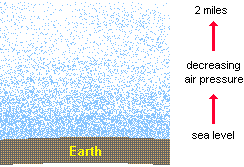 | ||
| | |||
| Click here for more information most the earth'due south temper | |||
| | |||
The pct of oxygen in the air at 2 miles (3.two km.) is essentially the aforementioned as at sea level (21%). However, the air pressure is 30% lower at the higher altitude due to the fact that the atmosphere is less dense--that is, the air molecules are farther autonomously.
When we breathe in air at sea level, the atmospheric pressure of well-nigh 14.vii pounds per square inch (1.04 kg. per cm. ii ) causes oxygen to hands laissez passer through selectively permeable  lung membranes into the claret. At high altitudes, the lower air pressure makes it more difficult for oxygen to enter our vascular systems. The outcome is hypoxia , or oxygen impecuniousness. Hypoxia usually begins with the inability to practice normal physical activities, such equally climbing a short flight of stairs without fatigue. Other early symptoms of "high altitude sickness" include a lack of appetite, vomiting, headache, distorted vision, fatigue, and difficulty with memorizing and thinking clearly. In serious cases, pneumonia-similar symptoms (pulmonary edema ) due to hemorrhaging in the lungs and an abnormal accumulation of fluid around the brain (cerebral edema ) develop. Pulmonary and cognitive edema usually results in death within a few days if at that place is not a return to normal air pressure levels. There is also an increased chance of center failure due to the added stress placed on the lungs, heart, and arteries at high altitudes.
When we travel to high mount areas, our bodies initially develop inefficient physiological responses. In that location is an increment in animate and heart rate to every bit much as double, fifty-fifty while resting. Pulse rate and blood pressure get upwards sharply every bit our hearts pump harder to get more than oxygen to the cells. These are stressful changes, especially for people with weak hearts.
| Initial inefficient | 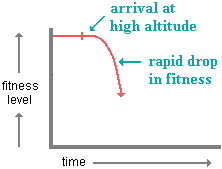 |
After, a more than efficient response normally develops as acclimatization takes place.Additional cherry claret cells and capillaries are produced to conduct more oxygen. The lungs increase in size to facilitate the osmosis of oxygen and carbon dioxide. There is also an increase in the vascular network of muscles which enhances the transfer of gases.
| Beginning of | 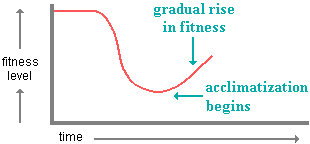 |
However, successful acclimatization rarely results in the aforementioned level of physical and mental fitness that was typical of altitudes close to sea level. Strenuous exercise and memorization tasks nonetheless remain more difficult. In addition, the rate of miscarriages is normally higher at altitudes to a higher place two miles because fetuses receive less oxygen from their mothers.
| Increased fitness | 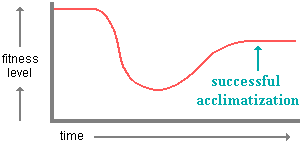 |
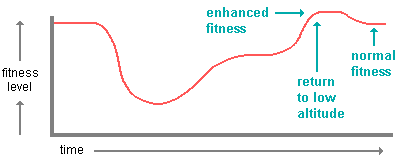
On returning to ocean level subsequently successful acclimatization to high distance, the torso usually has more reddish claret cells and greater lung expansion capability than needed. Since this provides athletes in endurance sports with a competitive advantage, the U.S. maintains an Olympic training center in the mountains of Colorado. Several other nations also train their athletes at loftier altitude for this reason. All the same, the physiological changes that consequence in increased fitness are curt term at low altitude. In a affair of weeks, the body returns to a normal fitness level.
| Enhanced fitness level for a brusque menstruum of time after returning to depression distance | |
Who Is Most Likely to Have High Distance Sickness?
Most lowland people begin to develop hypoxia symptoms at 1-ii miles altitude. However, there are some permanent settlements in the Andes Mountains in South America and the Himalaya Mountains in Asia that are at altitudes of 3 miles. Mountain climbers have reached peaks that are over 5 miles high, but only rarely without using tanks of oxygen to assist in breathing. The highest peaks are too loftier for whatsoever homo to acclimatize to the point that they could stay there for prolonged periods.
| Climbers at the peak | 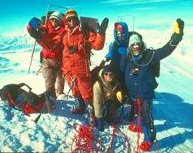 |
There is considerable variability between individuals and between populations in their power to adjust to the environmental stresses of high mountain regions. Usually, the populations that are most successful are those whose ancestors have lived at high altitudes for thousands of years. This is the case with some of the indigenous peoples living in the Andes Mountains of Peru and Bolivia besides every bit the Tibetans and Nepalese in the Himalaya Mountains. The ancestors of many people in each of these populations have lived above xiii,000 feet (ca. 4000 meters) for at least 2,700 years.
| Peruvian Indian | 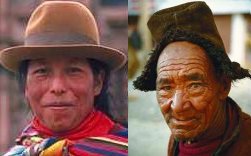 | |
| (Her cheeks are red primarily due to increased |
The implication is that natural choice over thousands of years results in some populations being genetically more suited to the stresses at high distance. Nevertheless, dissimilar populations respond physiologically to low oxygen pressure in somewhat different means. The chief solution of Indians from the high mount valleys in Peru and Bolivia has been to produce more hemoglobin in their blood and to increase their lung expansion adequacy. Both result in an increase of oxygen carried by the blood. In dissimilarity, the common solution of Tibetans and Nepalese who alive at high altitudes generally has been to exhale faster in order to have in more than oxygen and to accept broader arteries and capillaries, thereby allowing much higher rates of blood flow and subsequently greater amounts of oxygen delivered to their muscles, despite the fact that they accept relatively normal hemoglobin levels. A recent report of Tibetan villagers who alive their lives at around 15,000 feet has shown that they have 10 oxygen-processing genes not normally found in lowland populations. The EPAS1 gene is particularly of import in adapting to environments with consistently depression oxygen pressure.
Whether you personally will feel high distance sickness in the future may be at least partly a consequence of your genetic inheritance. Those individuals who have low expression levels of the PDP2 gene by and large have more severe symptoms. This factor codes for a poly peptide that assists in the conversion of food into fuel for our bodies. In some fashion, it apparently as well helps in acclimatization to depression oxygen pressure.
NEWS: In the March xv, 2011 issue of the Periodical of Epidemiology & Customs Health, researchers from the University of Colorado School of Medicine and the Harvard School of Global Health reported that people more often than not live longer at loftier altitudes and accept a lower risk of dying from coronary avenue disease. This positive event occurs unless people accept chronic breathing problems. The researchers speculated that mild hypoxia improves the manner the eye functions and produces new claret vessels that increase blood flow for the heart. An culling explanation presented by the authors is that increased exposure to ultraviolet radiation from the sun at higher altitudes increases the trunk'south ability to produce vitamin D, which has beneficial effects on the heart.
Copyright � 1998-xx12 by Dennis O'Neil. All rights reserved.
illustration credits
Source: https://www2.palomar.edu/anthro/adapt/adapt_3.htm
Posted by: knightknoble.blogspot.com
0 Response to "What Is The Make Up Of Air As Altitude Increases What Is The Makeup Of Air As Altitude Increases"
Post a Comment